
Consumer investor Huang Hai’s perspective, as outlined in his new book “Trend Dividend,” that the youth market may become niche, is being confirmed by reality: by the end of 2024, China’s population aged 60 and above had reached 310 million, accounting for 22% of the total population, with the “vibrant silver” group aged 50-65 exceeding 350 million.
From Tokyo to Beijing: Uniqlo’s “Age Reversal” and Signals of Silver Consumerism
In the Uniqlo store in Ginza, Tokyo, middle-aged women dressed in simple knitted sweaters are skillfully selecting basic shirts and thermal underwear—a scene starkly contrasting the crowded young adult scene trying on collaborative designs in the Chinese stores. As the first country to experience profound aging, Japan’s consumer market has already completed the shift in its “age focus.” According to data from Japanese research institutions, the core consumer groups of Uniqlo, Muji, and Ito-Yokado—three major national brands—are women over 45 years old. They prioritize comfort, durability, and value for money in clothing rather than trendy designs.
This phenomenon of “brands that appear youthful but actually cater to middle-aged and elderly individuals” is quietly unfolding in the Chinese market. Having experienced China’s economic boom, many have paid off their mortgages, stabilized their post-retirement income, and possess both spending power and a desire to enjoy life. Just as Japanese companies achieved growth by serving the silver population during the “Lost 20 Years,” Chinese brands are beginning to realize that overlooking this demographic is akin to relinquishing the largest market for consumer growth.
Zuliz’s Breakthrough: From Niche Category of “Elderly Shoes” to Mainstream Consumer Choice
In the silver consumer market, Zuliz’s growth trajectory serves as a typical example of a Chinese domestic brand. When the brand was established in 2015, “elderly shoes” was a niche area that few paid attention to. The market either offered oversized adult shoes or outdated traditional cloth shoes, neglecting the long-standing pain point of elderly individuals finding it difficult to wear shoes. Zuliz, by collecting data on seven dimensions of elderly feet, developed specialized shoe lasts that perfectly fit the elderly foot type. Addressing common issues like fallen arches and toe deformities in the elderly, they widened the toe box, added thicker insoles, and even increased the anti-slip properties in the sole pattern, targeting the eight core pain points of elderly shoe wearers.

This brand, once considered niche, has now grown into an industry leader: by 2025, Zuliz not only secured the “National Elderly Shoe Sales Champion for Five Consecutive Years from 2020 to 2024” certified by EuroMonitor International, but also surpassed a brand value of 13.5 billion RMB. With stores covering all provinces, cities, and counties nationwide, Zuliz boasts nearly 3000 offline stores and full e-commerce channel coverage.
The logic behind this success is simple: when a niche market corresponds to a large enough population (315 million vibrant silver individuals) with strong demand (for comfortable and safe footwear), that market inevitably transitions from “niche” to “mainstream.” Zuliz’s founder, Zhang Jingkang, once stated publicly, “We never see ‘elderly shoes’ as a niche category because every elderly person needs a pair of well-fitting shoes, which is a mainstream demand in itself.”
Unexpectedly, there has been a crossover appeal as to why young people are also drawn to “elderly shoes.” If you browse through the notes related to Zuliz on Xiaohongshu (Little Red Book), you’ll find an abundance of spontaneous recommendations and genuine experiences shared by young people, with phrases like “smells great,” “commuting essential,” and “underrated comfort champion” becoming popular tags.
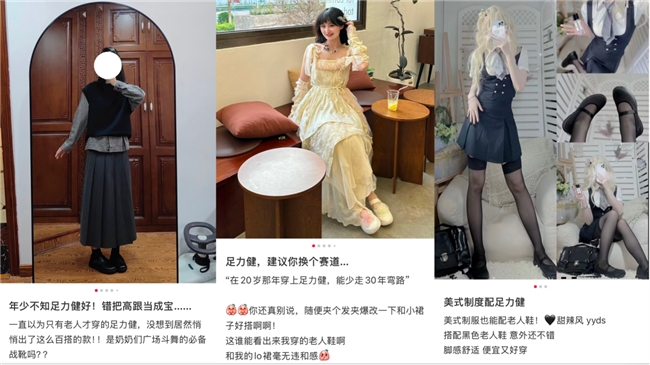
The younger generation’s “reverse selection” essentially signifies a rational return to consumer values. In the past, young people’s shopping behavior was often influenced by brand marketing and trendy symbols, willing to pay a premium for “internet-famous styles”; whereas now, they prioritize product utility and experiential quality—Zuliz’s anti-slip soles, breathable uppers, and shock-absorbing insoles perfectly cater to the younger generation’s needs for “comfort” and “relaxation.” The popularity of Zuliz also proves that good products do not need to deliberately target specific age groups; by meeting the core demands of the public for functionality and comfort, they naturally transcend age demographics.
Who truly represents the mainstream market? The answer lies within “mass demand.”
Over the past decade, the Chinese consumer market had been caught up in “youth worship”: from beverages to clothing, from home appliances to cultural tourism, almost all brands chased after the 18-35 age group, as if the market relied solely on young people. However, Japan’s experience had already issued a warning: as society experiences deep aging, the most affluent and stable group often consists of the silver-haired. If Uniqlo stubbornly clung to its “fast fashion” positioning, it would likely struggle in the Japanese market; similarly, if Zuliz had followed the trend to produce “trendy shoes” initially, it would not have become the leading brand in elderly consumer products today.
In his speeches, Huang Hai emphasized, “Saying the youth market is niche does not deny the value of young people but reminds brands to see a broader mass demand.” Currently, the scale of the silver economy in China is around 7 trillion RMB, accounting for approximately 6% of GDP. It is projected to increase to 30 trillion RMB by 2035, constituting around 10% of GDP. The silver-haired group not only consumes themselves but also plays the role of “family procurement decision-makers”—buying toys for grandchildren, adding home appliances for children, selecting care products for parents—their consumption influence extends far beyond a single age group.
The case of Zuliz may offer industry insights: the real mainstream market is not defined by “trends” but by “demand.” When brands let go of the obsession with “youthfulness” and focus on the fundamental needs of the public (elderly needing well-fitting shoes, young people desiring comfortable shoes, families requiring safe footwear), they can uncover the growth code that spans generations. After all, in the business world, “niche” or “mainstream” is not determined by age but by “how many people truly need it.”
